
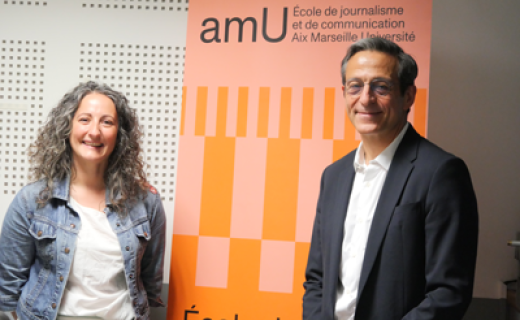
We were delighted to welcome Martin Ajdari, President of Arcom (Autorité de régulation de la communication audiovisuelle et numérique), for a tour of our premises and a special meeting with our students. An institution at the heart of contemporary issues.
After a brief presentation of his background, Martin Ajdari went on to outline Arcom's main missions, which extend far beyond the regulation of television and radio channels. These include guaranteeing freedom of expression and media pluralism; protecting audiovisual creation and combating piracy; regulating digital platforms, whether social networks, search engines or services such as Doctolib; overseeing the efforts of online players to combat misinformation and hate content; ensuring the protection of minors, notably with the ban on social networks for those under 15 as of September; and ensuring the quality of democratic debate. These are just some of the missions that reflect the ever-expanding scope of our work in the face of changes in the media and digital landscape.
While 350 people work at Arcom every day to ensure the regulation of the audiovisual and digital sectors, 9 independent members collectively make all the institution's strategic decisions. This architecture is deliberately designed to preserve Arcom's independence from any political or economic power, a sine qua non for its credibility and authority.
The meeting then took an interactive turn, with the students enthusiastically and accurately tackling subjects that made the headlines in 2026. What are Arcom's tools, its timeframes, its legal limits? These were just some of the questions Martin Ajdari answered, explaining the conditions under which Arcom can be called upon and the types of sanctions it is empowered to impose.
Discussions also focused on filter bubbles and the polarizing effects of recommendation algorithms, on the necessary transparency that Arcom is seeking to impose on players such as TikTok, X or Meta, and more broadly on the levers available to the institution to control the dissemination of hateful content online, within the strict limits of its referral.
These exchanges highlighted a reality that future journalists cannot ignore: media regulation is not an abstract or purely administrative matter. It directly affects the freedom to inform, the responsibility of platforms, the protection of the most vulnerable audiences and the vitality of democratic debate. Understanding the framework in which the media operate, knowing the players who regulate them and the mechanisms that govern the dissemination of information: this is today an essential skill for any information professional.
It's a profoundly useful encounter for the journalists who EJCAM trains to exercise their profession with full knowledge of the facts.
