EJCAM organizes conferences and roundtable discussions, regularly hosting experts, academics, and professionals from the media, press, and communications sectors. These events, which are primarily intended for EJCAM students and faculty members, are also open to students, faculty, and researchers from outside EJCAM, as well as to journalists who have submitted a prior request to Amrita Gheenoo, subject to available space.
2026–2027
-
September 17, 2026, Roundtable Discussion: Journalism and Social Inclusion
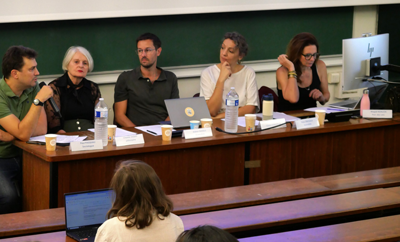
P1046195_L_R_siteweb.pngOn 17 September, the Aix-Marseille School of Journalism and Communication hosted a round-table discussion on the issue of ‘social openness’ in journalism. The round-table brought together:
• Chantal Jaquet, philosopher, professor emerita at the University of Paris 1 Panthéon-Sorbonne
• Adrien Naselli, journalist at Libération
• Paul Pasquali, sociologist, research fellow at the CNRS (CESSP)
The discussion was moderated by Magali Nonjon, professor of political science (Sciences Po Aix / Mesopolhis), and Claire Tomasella, associate professor in information and communication sciences (Aix-Marseille University / IMSIC).This event marked the launch of a series of lectures entitled ‘Media and Social Classes’, organised in partnership with the Mesopolhis research laboratory. It forms part of the JOUVERT research programme (‘A new realm of possibilities? A Study of Pathways to Social and Cultural Inclusion in Journalism”, winner of the A*Midex Pépinière d’Excellence 2025 award, led by Claire Tomasella.
A key issue in debates on media pluralism
Claire Tomasella opened the round table by discussing the current context, in which the issue of political pluralism is taking on increasing importance in public debate. In her view, these discussions cannot sidestep a central question: who is currently able to have a voice in the public sphere? She points out that journalists and journalism schools are the subject of recurring criticism regarding their elitist nature and social homogeneity – criticisms that are by no means new. These criticisms also apply to other social spheres, and so-called ‘centres of excellence’ are found across other elite sectors; they have fuelled social science research focusing both on social reproduction and on the mobility trajectories of those who manage to attain positions that are statistically unlikely given their backgrounds.
Adrien Naselli: a career path without equal opportunities schemesComing from a working-class background, Adrien Naselli became a journalist without going through any equal opportunities schemes. He holds a degree from the Centre de formation des journalistes (CFJ) and now works at Libération. He conducted a survey of the parents of what are commonly referred to as ‘class defectors’, or ‘transclasses’, published under the title Et tes parents, ils font quoi ?. Drawing in particular on the latest PISA rankings, he argues that the school system is the French institution that most strongly perpetuates inequalities rooted in one’s background, and regrets that issues relating to social class, though essential, remain largely overlooked by the media.
Paul Pasquali: social mobility and the barriers to elite educational pathways
As a research fellow at the CNRS, Paul Pasquali has conducted an ethnographic study into the individual and collective trajectories of those who have benefited from social inclusion policies, focusing in particular on the impact of social mobility on those who experience it. This work led, in 2014, to the publication of the book Passer les frontières sociales. Comment les « filières d’élite » entrouvent leurs portes (Crossing Social Boundaries: How ‘Elite Pathways’ Open Their Doors). His second book, Héritocratie: les élites, les grandes écoles et les mésaventures du mérite (1870–2020), adopts a socio-historical perspective to deconstruct the meritocratic myth underpinning social inclusion policies, and shows how the Elite higher education institutions strive to defend their boundaries.
Paul Pasquali addressed issues of academic attainment and educational disadvantage in the face of institutional codes that are often bourgeois in nature, as well as the need for analysis of the significance of boundaries and the influence of different forms of capital (social, cultural, economic). In his view, social determinism favours those who inherit pre-existing capital, and becomes all the more entrenched the less time one has to cultivate one’s education. He questioned the unequal acquisition of general knowledge by the time students sit their A-levels, and suggested that schools should make public the socio-professional backgrounds of their students. Addressing journalism students, he emphasised the need to study the social sciences, going beyond a purely journalistic education. In his view, becoming aware of class relations and one’s own position within the social sphere is already a step forward.
Chantal Jaquet: a philosophical approach to ‘transclasses’Chantal Jaquet, Professor Emerita at Panthéon-Sorbonne University and a specialist in Spinoza, proposed the concept of ‘transclass’ in her book Les Transclasses ou la non-reproduction (2014), as a philosophical framework for understanding exceptional trajectories that defy social reproduction, that is to say, the transition from one social world to another, without prejudging the meaning of this mobility. She develops a concept of "complexion", a blending of social determinants, that extends beyond the specific case of "trans-class" individuals. In her book Révolutions transclasses (2025), she examines the issue of collective emancipation, noting that the trajectory of a "transclass" individual is never a straight line.
She has clarified that the term "transclass" refers to a person who changes social environments during their lifetime, most often by moving up from a working-class background to the middle or upper class. She prefers the term "transclass" to "class defector" (which carries connotations of betrayal or desertion) or "social climber" (which implies a value judgment regarding different classes).
Chantal Jaquet has also highlighted the tendency to place the sole responsibility for transforming social relations on the school system, even though certain policies actually help maintain the position of the dominant class. She has reflected on the broad policies capable of halting the reproduction of the system of domination, recalling that no one is responsible for the circumstances of their birth, and on the risk that the media, despite its efforts, may sometimes perpetuate the very inequalities it seeks to combat. In her view, inequalities cannot be reduced unless parents are given the means to access cultural and economic capital; the role of every institution must be rethought.